

Share with your friends!


Share with your friends!
According to Statista, as 2023 draws to a close, it is now clear that e-commerce turnover continues to grow year on year. With turnover of 89.4 billion euros, online retail is setting new records.
It is therefore hardly surprising that an ever-increasing number of businesses are opting for an online shop. This inevitably raises the question of which e-commerce platform to choose – a decision with far-reaching consequences that should not be taken lightly. Our ‘Shopify vs. WooCommerce’ comparison aims to pit the two most popular providers against each other and provide a comprehensive overview of the pros and cons of each platform.
Is our detailed comparison too long for you? If so, here’s an overview of the key points to help you quickly decide whether Shopify or WooCommerce is the right platform for you.
Before we get started and I outline the strengths and weaknesses of Shopify and WooCommerce, I’d first like to give you a brief introduction to both.
Shopify was founded in 2006 by Tobias Lütke, Daniel Weinand and Scott Lake. The idea came about when Lütke tried to set up an online shop for his snowboard products but was dissatisfied with the existing platforms. To retain control over his shopping experience, he began developing his own platform. These efforts led to the creation of Shopify, an e-commerce solution that quickly gained popularity and became one of the leading platforms for online retail. Shopify stands out for its user-friendliness, flexibility and comprehensive features, which enable retailers to effectively manage and expand their online presence.
WooCommerce, on the other hand, is an e-commerce solution developed as a WordPress plugin. The story of WooCommerce began in 2011, when the developers at WooThemes realised that there was a lack of robust, user-friendly e-commerce integration for WordPress. In response, WooCommerce was launched to seamlessly transform WordPress websites into fully functional online shops. The platform has quickly become one of the most popular solutions for businesses wishing to sell their products online. With a wide range of extensions, a strong developer community and the integration of WordPress as its foundation, WooCommerce offers a flexible and customisable solution for online retailers.
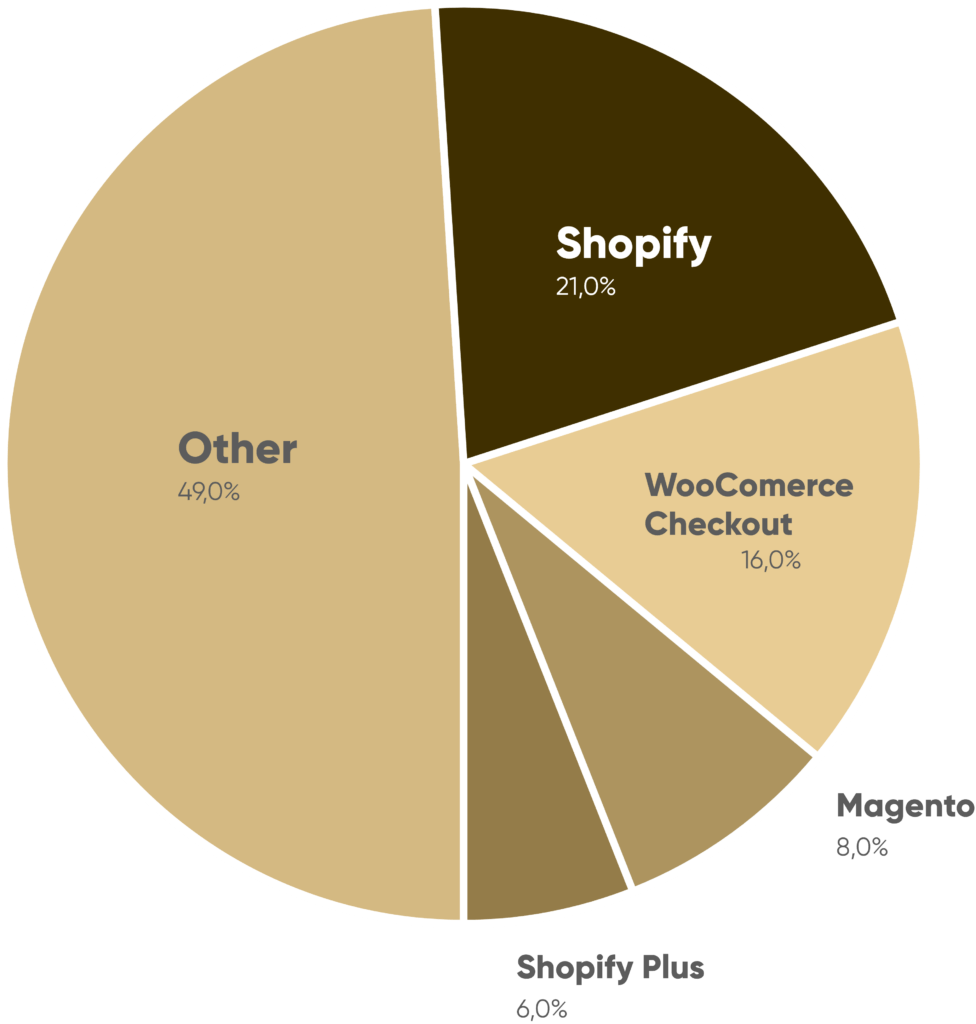
The latest data from Builtwith confirms the dominance of Shopify and WooCommerce. They analysed the top 1 million online shops and concluded that Shopify powers 21 per cent and WooCommerce 16 per cent of all e-commerce stores. With Shopify Plus, the Canadian company accounts for a further 6 per cent; this service is aimed primarily at large enterprises.
Compared with historical data, Shopify has overtaken WooCommerce as the market leader; however, depending on your requirements, WooCommerce may still be the better choice. That’s why we’d like to offer you a comprehensive comparison based on 10 criteria.
One aspect that should not be underestimated is user-friendliness. Shopify is clearly ahead in this respect – which makes sense, as this was, after all, the key factor in launching the e-commerce solution. Setting up a shop on Shopify is kept very simple and can be done quickly, even by complete beginners.
As WooCommerce is a WordPress plugin, the first step here is to set up the WordPress CMS; this can be a little more complicated and requires some technical know-how.
Whilst Shopify comes with almost all the necessary features as a complete package, WooCommerce can be seen more as a modular system, where users can put together all the components they need within the WordPress ecosystem. This isn’t necessarily a disadvantage, but WooCommerce definitely has a steeper learning curve than Shopify.
One of the most significant differences between Shopify and WooCommerce is hosting. Whilst Shopify takes care of hosting for you, with WooCommerce you have to set up your own hosting.
Shopify’s hosting is cloud-based and included in the monthly fees. This approach is more hassle-free and can be scaled more easily. Thanks to automatic management running in the background, you won’t even notice it’s happening and it’s one less thing you need to worry about.
WooCommerce is self-hosted, which means that when setting up your online shop, you’ll need to arrange the hosting yourself; to do this, you can either set up your own server or choose a third-party provider’s server.
Shopify comes out on top here too. Self-hosting can be complicated and confusing, particularly for those new to online retail. Whilst choosing your own server does have its advantages, the cloud solution is the clear winner when it comes to convenience.
Of course, costs also play a part in running an online shop. However, it is difficult to compare them directly. This is because Shopify offers an all-in-one solution, whilst WooCommerce and WordPress are initially free, open-source platforms.
WooCommerce can therefore be run entirely free of charge to begin with and requires only a hosting package – which costs around 10–15 euros for a medium-sized online shop – and a domain name. In addition, fees may apply depending on the payment provider.
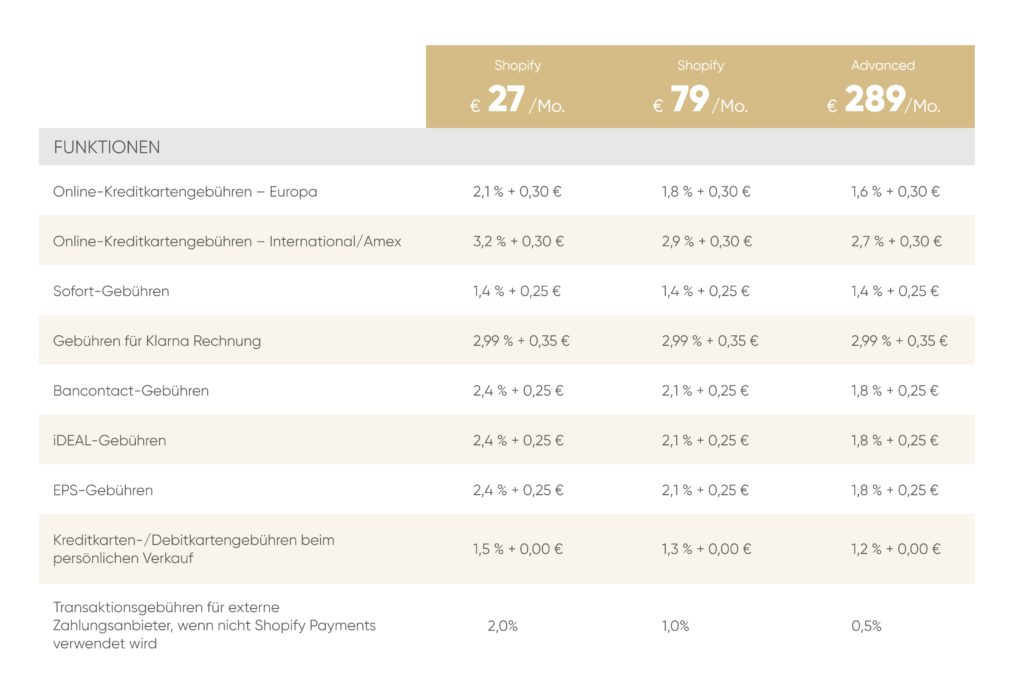
Shopify costs consist of a monthly payment and fees per sale. The monthly costs amount to:
If you pay annually, you’ll receive a 25 per cent discount; here’s an overview:
To ensure your shop remains competitive, you’ll also need additional themes, plugins or apps. There’s a wide range of both free and paid options available.
This is where WooCommerce really shines with its open-source approach; in theory, this makes it possible to get started very cheaply, although it does require some programming knowledge. Generally speaking, WooCommerce’s costs are more variable, whereas with Shopify it is relatively straightforward to see exactly what the costs amount to.
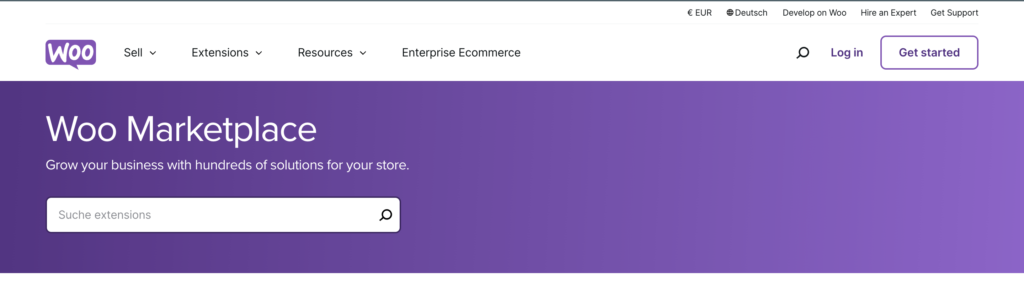
Whilst Shopify is one of the more flexible hosted solutions, WooCommerce clearly has the edge in terms of flexibility thanks to self-hosting. WooCommerce already provides you with a solid foundation for your shop; in theory, you can build any further solutions yourself without restrictions (provided you have programming skills), but for 99 per cent of issues there’s already a plugin available that can be integrated with minimal effort. Often, these are even free. In the Woo Marketplace, you’ll find numerous plugins specifically designed for WooCommerce.
Shopify also offers various options in the Shopify App Store to expand your shop, although the choice here is limited. In addition, there are some areas that cannot be easily customised. The situation is similar when it comes to design. Whilst there are virtually no limits in WordPress, Shopify always has a similar structure.

WooCommerce leaves nothing to be desired when it comes to features and has the upper hand in this respect. Unlike Shopify, there are virtually no restrictions here.
A rapidly growing business needs an infrastructure that can scale easily. As the operator of an e-commerce business, you don’t want your own shop to become a bottleneck.
The good news is that both Shopify and WooCommerce are scalable. However, the circumstances differ. Thanks to cloud hosting, Shopify adjusts your shop’s capacity to ensure scalability at all times.
With WooCommerce, choosing the right server is crucial. If the server isn’t equipped to handle high traffic volumes, this can lead to problems. This can be particularly problematic during sales events such as Black Friday or other special occasions. If your business grows steadily, the server can simply be upgraded in the future.
When it comes to scalability, Shopify offers the simpler solution, which can also cope with traffic spikes. WooCommerce users need to keep a close eye on server load at all times and are actively involved in this process.
In recent years, expectations of online shops have continued to rise. Fast loading times are an extremely important factor in ensuring a good user experience and are now taken for granted. If the site is not stable and takes too long to load, the bounce rate rises sharply.
Here, too, there is no clear-cut answer to the Shopify vs. WooCommerce comparison. WooCommerce’s speed depends once again on the hosting provider; it is very important to choose the right package to minimise delays. This can quickly become expensive. WooCommerce itself is somewhat sluggish by nature, so a cache plugin is essential; this allows HTML, CSS and JavaScript code to be compressed, which is absolutely vital.
Shopify already has these features, so it’s once again less hassle. There’s also a selection of themes specifically optimised for loading speed. Feel free to have a read of our Shopify Themes Guide.
An important consideration for both platforms is the use of apps and plugins. Whilst there is a wide range to choose from and many useful features can be added, this often comes at the expense of speed. It is therefore advisable to keep the shop system as streamlined as possible.
When it comes to stability, Shopify has the edge. Thanks to its cloud-based hosting, updates are installed automatically. With WooCommerce, updates must be installed manually, so it requires more maintenance. Failing to install updates can lead to security vulnerabilities, so all new updates should be installed as soon as possible.
Once again, Shopify impresses with its cloud hosting. It involves less administrative work and is easier to use. Whilst WordPress can, as always, work just as well – if not better – it requires more effort.
When it comes to accepting payments, there is just one rule: the more, the better. If customers cannot find their preferred payment method whilst shopping online, they may not go ahead and purchase the item they want.
By offering more payment methods, you can therefore make your shop more attractive. The good news is that both Shopify and WooCommerce support several payment systems.
WooCommerce supports all common payment methods, including PayPal, Stripe, Square and even regional providers. However, many of these payment gateways require a plugin, some of which incur additional costs. By default, only direct bank transfer, cheque, cash on delivery and PayPal are integrated.
Shopify has its own payment system, Shopify Payments, which requires no further configuration and incurs no additional fees. Whilst Shopify also supports other payment gateways, it charges additional fees for their use. Depending on your Shopify plan, these fees amount to 2 per cent, 1 per cent or 0.5 per cent.
Shopify penalises customers who do not wish to use its own payment gateway, whilst WooCommerce, on the other hand, offers greater freedom. That said, Shopify is ready to go straight away with no further effort required when using Shopify Payments, whereas WooCommerce requires further configuration.
The GDPR (General Data Protection Regulation) has been in place since 2018 to protect internet users. It is designed to safeguard privacy and security. For website operators, this primarily means a great deal of work and costs that could threaten their very existence should they fail to comply with the guidelines.
Shopify is fully aware of the GDPR in Europe and offers a legally compliant theme that has even been certified by the Händlerbund in Germany. Furthermore, every Shopify shop comes with an SSL certificate and is also PCI-DSS compliant at the highest level. This means that customers can browse the site with the highest security standards, and credit card transactions are also processed securely. In addition, Shopify takes care of the latest updates automatically.
WooCommerce, on the other hand, was not designed for the European market and must therefore be set up by the site operator in accordance with the GDPR. All reputable hosting providers include SSL certificates as standard; for everything else, there are plugins available that can help. However, achieving GDPR compliance for your WooCommerce shop may incur additional costs.
The fact that Shopify is already GDPR-compliant by design should be seen as a clear advantage. This can save you a lot of headaches. A legally compliant cookie banner is also a must for your online shop; you can find our guide to the Shopify cookie banner here
Only those who can be found online can actually sell their products. Search engine optimisation plays a particularly important role in this regard, as a large proportion of e-commerce turnover is generated through organic traffic.
WooCommerce’s code is already SEO-optimised, and you can customise the meta descriptions, titles and URLs of your product pages. So the basics are already taken care of by WooCommerce.
In addition, there are once again some useful plugins here that make search engine optimisation easier for you. Yoast SEO is particularly popular; even beginners can get started with it, as the plugin provides recommendations for many SEO-related practices.
Shopify also allows you to implement basic SEO practices; here too, there are plugins that offer advanced features. With the SearchPie app, for example, your entire shop can be scanned and you can use the report to make improvements.
Both platforms are SEO-friendly; WooCommerce once again offers complete flexibility in this regard, but top rankings for relevant search terms can also be achieved with Shopify. As with all marketing activities, search engine optimisation should be left to the experts. Mistakes are often made at the outset due to a lack of knowledge, which can harm online visibility; the choice of platform plays a secondary role in this regard.
Whether it’s WooCommerce or Shopify SEO, we’re happy to help and can offer you everything from an initial consultation on search engine optimisation, through setting up a solid foundation, right through to comprehensive support for your shop.
Although Shopify is easy and intuitive to use, you’re unlikely to manage it entirely without any help. To help everyone get started in online retail, the Canadian company offers a range of support options.
First and foremost, the platform features a help centre with articles, tutorials and guides. For those who prefer videos, Shopify runs a YouTube channel and hosts regular webinars.
If you’re fluent in English and want to learn all the basics of Shopify from scratch, the Shopify Academy is the best place to start. Here you’ll find free courses to help you expand your knowledge.
If you’re stuck with a problem and can’t sort it out on your own, there are ways to get help here too. On the official Shopify forum, you can chat to other users and ask questions about any issues you’re having. You can also contact the Shopify Support Team by email, live chat or phone, 24 hours a day.
WooCommerce also offers a number of self-help resources. The official documentation provides a wealth of helpful guides on how to run a successful online shop using WooCommerce. However, this is in English. The WooCommerce blog is also packed with useful information and sound advice.
Last but not least, it all comes down once again to choosing a reliable hosting provider. For an online shop, downtime or poor performance can often be disastrous, which is why 24/7 support is so important.
Shopify places great importance on providing its users with all the information they need. Support is also included in the price. WooCommerce also has plenty of useful resources, but here the community plays a more prominent role. Support depends on the hosting provider and their level of expertise.
In conclusion, it can be said that there is no clear winner. Whether Shopify or WooCommerce is a better fit for your business depends on your requirements and preferences.
The fundamental differences are clear. Shopify stands out for its user-friendliness and focus on the essentials. WooCommerce, on the other hand, with its open-source approach, offers complete creative freedom and relies on users taking responsibility for their own projects.
Together, the two platforms account for 43 per cent of the top 1 million online shops. Both are therefore extremely popular, and both will continue to support numerous retailers in running their online shops over the coming years.
Want to find out more? In our comprehensive guide, you’ll find everything you need to know about setup, design, marketing, checkout, SEO and scaling with Shopify.
Whether Shopify or WooCommerce is better depends on your goals. Shopify is a hosted, all-in-one solution that is easy to use, quick to set up and comes with built-in features. WooCommerce, on the other hand, is more flexible as it is based on WordPress and allows for greater customisation – but it does require more technical know-how.
Shopify is a good choice if you want a fast, stable and scalable solution that requires no technical effort. Shopify takes care of updates, hosting and security automatically. WooCommerce requires more work on your part and the use of plugins, but in return offers full control over design and functionality.
Switching from Shopify to WooCommerce is worth it if you want maximum customisation and are prepared to take on more responsibility for technical aspects, hosting and maintenance. Stick with Shopify if simplicity, support and an integrated infrastructure are more important to you.
The main differences between WooCommerce and Shopify lie in their structure and functionality. WooCommerce is a WordPress plugin that enables users to create and manage an online shop. Shopify, on the other hand, is a standalone platform that provides all the necessary e-commerce features. This means that Shopify handles hosting and management, whilst WooCommerce requires installation on your own server.
The advantages of WooCommerce include its flexibility and customisability, as it offers a wide range of plugins and themes. Furthermore, it is free, which makes it attractive to many small businesses. However, the disadvantages are that setting it up and maintaining it requires technical knowledge, and there may be additional costs for hosting and a domain name.
Shopify offers a user-friendly interface and built-in features that make it easy to set up a shop. The platform takes care of hosting and security, making it straightforward to use. One drawback is that the monthly cost of a Shopify plan can be higher than that of WooCommerce, particularly if you require advanced features.
Migrating from Shopify to WooCommerce can be a challenge, as it involves exporting products, orders and customer information and importing them into the WooCommerce system. However, there are tools and plugins available that can simplify this process, allowing users to transfer their data with ease.
Choosing the right Shopify theme depends on your individual business needs. Popular themes are often customisable and offer a variety of layouts to enhance the user experience. Furthermore, Shopify offers a wide selection of free and paid themes that are easy to customise.
WooCommerce enables users to manage products, accept payments and set up delivery options. Useful plugins for WooCommerce include those for SEO, security features and the integration of payment providers. These extensions help to improve the shop’s functionality and optimise the user experience.
The Shopify Community offers a wide range of resources, including forums, tutorials and the Shopify Learn portal. These platforms help new users find their way around the Shopify environment and find answers to common questions. In addition, users can benefit from the experiences of others and gain valuable tips on setting up and managing their shop.