
Website relaunch more SEO & conversion success
Individual and holistic: customized strategy for your project
More SEO traffic, more conversions and more sales after the reboot
Relaunches and redesigns without headaches: smooth process thanks to experienced experts







What makes the relaunch successful
Is your website stuck in 2010? Then it's time for a website relaunch!
But be careful, a website relaunch should always be done with a professional. A website relaunch is an extremely sensitive intervention in your online business. Complications in the implementation can lead to major losses in SEO visibility.
As an online marketing agency, we will be happy to advise you on this topic and, if you wish, implement the complete relaunch for you, so you can be sure that everything will run smoothly and that the relaunch will have a positive effect on your project.
This is how we support you with your website relaunch

Relaunch planning

Selection of the right CMS and integration

Design SEO requirements

Conversion optimized website design

Implementation of the relaunch

Setting up tracking

Redirect management

Go-live
Symptoms
- Your page loads forever
- High bounce rate on your page
- Below average conversion rate
- But you do not really know why

Does that sound familiar?
With an outdated website, you're scaring away potential customers who would have bought. Your website represents your brand on the Internet. In today's world, visitors expect certain quality standards that cannot be met with a standard website. We help you to communicate the value of your brand to your customers by relaunching your website.
Use the website relaunch as an opportunity
We help you to clearly structure your website in the relaunch to create a technically flawless basic framework.
Thus, the website relaunch can also be used to fix previous problems in technical SEO, tracking or menu navigation from scratch.


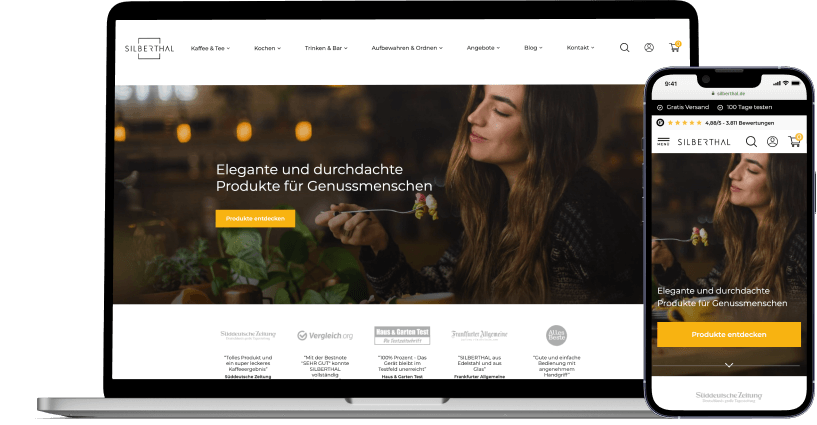
Our website relaunch process in detail
Objective: Clearly define the goals for the website relaunch (e.g. increase lead generation, improve conversion rate, increase online visibility, etc.).
Target group analysis: Identification of target groups and definition of personas to ensure that the new website meets their needs and expectations.
Competitive analysis: analysis of competitors' websites to ensure that the new website is competitive in comparison.
Content strategy: planning and creating content for the new website to ensure it is relevant, engaging and search engine optimized.
Design and usability optimization: design of the new website with a responsive design, optimized user experience and easy-to-understand navigation.
Technical implementation: Implementation of the technical requirements for the new website, such as responsive design, fast loading times, search engine optimization and security measures.
Launch strategy: planning the website launch and content publishing to ensure that the website is easily accessible to the target audience.
Post-launch optimization: Continuous monitoring and optimization of the new website to ensure that it achieves its goals and is continuously improved.
How we measure the success of your website relaunch
To measure the success of a website relaunch, there are several metrics we track for you. Here are the most important metrics:
Traffic: We track whether traffic to your website has increased or decreased after the relaunch.
Conversion rate: The conversion rate measures the percentage of website visitors who perform a specific action, such as making a purchase or filling out a form. After the relaunch, this signifikat should increase
Bounce Rate: The bounce rate indicates how many visitors leave your website without taking any further action. A high bounce rate can indicate that your website is not engaging or user-friendly. We track the bounce rate to see if the relaunch has helped reduce the bounce rate.
Search engine ranking: We check whether your website ranking in search engine results improves after the relaunch.
User feedback: Feedback from users of your site to can also help you see if the relaunch has had a positive impact. We can use surveys, ratings or comments for you to collect feedback from users.
It is important to regularly check whether the set goals are being achieved and whether further adjustments are needed to ensure the success of the website relaunch.
The consequences of an outdated website
An outdated website can have several negative effects on your business, such as:
Loss of user experience: If your website is outdated, it may no longer meet your visitors' expectations. Outdated designs, slow load times, poor navigation, and cluttered content can cause visitors to leave your site and not return.
Loss of search engine rankings: An outdated website can also impact your search engine rankings. Search engines like Google prefer websites that are mobile optimized, have fast load times, and are user-friendly. If your website is not up to current standards, you may fall behind in search results and get less traffic to your website.
Lower conversion rate: An outdated website can also lead to a lower conversion rate. If your visitors are not satisfied due to poor user experience or outdated content, they are unlikely to become customers. A new, modernized website can help more visitors become customers.
Image damage: An outdated website can also lead to image damage. Visitors may get the impression that your company is not keeping up with the times or is not professional. A modern, appealing website can help visitors have a positive image of your company.
Security risks: An outdated website can also introduce security risks. If your website is not updated regularly, it can create security vulnerabilities that can be exploited by hackers. A modern, up-to-date website can help keep your visitors and your data safe.
Relaunch vs. redesign
The aim of a redesign is to make the website more visually appealing. However, contents such as page structure, menu and the basic concept remain the same. A website relaunch describes a complete redesign of the website. Here, the page is completely redesigned and, if necessary, rebuilt in a new structure.
Website relaunch FAQ
How long does a website relaunch take?
The duration of a website relaunch can vary greatly depending on the scope and complexity of the project. As a rule, a website relaunch can take between three months and a year.
A simple website redesign can be completed in a few weeks in some cases, while a comprehensive website relaunch that includes revamping the website structure, design, functionality and content can take several months.
The exact duration also depends on various factors, such as the size of the company, the complexity of the website, the budget and the availability of resources. To ensure that the website relaunch is completed in a reasonable time and with high quality, the steps and goals of the project should be clearly defined in advance.
What does a website relaunch cost?
The costs for a website relaunch can vary greatly, as they depend on various factors such as the size of the company, the complexity of the website, the desired functionality and the scope of the project. In a free initial consultation, after a short analysis, we can already give a rough indication of the costs.
How often should you relaunch a website?
Usually, a website relaunch is performed when the existing website is outdated, no longer meets the requirements or no longer corresponds to the current design and technology trends. It may also be necessary to perform a website relaunch to improve the company's online marketing or to improve the usability and functionality of the website.
After a carefully planned and professionally implemented website relaunch, a new relaunch is usually only necessary again in the long future. Active support, in which small optimizations are carried out again and again, also ensure that everything remains up-to-date after the relaunch.
What mistakes should be avoided when doing a website relaunch?
When relaunching a website, there are some mistakes that should be avoided. Here are some important points that should be considered:
- Lack of planning: A website relaunch requires careful planning to ensure everything goes smoothly.
- Neglecting SEO: If you don't pay attention to SEO during your relaunch, your search engine ranking may deteriorate.
- Non-responsive design: A non-responsive website can have a negative impact on user experience.
- Unclear goals: Before a website relaunch is carried out, clear goals should be defined.
- No backups: It is urgent to back up all files and content from the old website before the relaunch goes live.
- Insufficient testing: Before launching, an extensive testing period should be conducted to ensure that all website features are working smoothly.
- No training: If necessary, training employees with the new CMS can make the transition easier.
What are the benefits of a website relaunch?
A website relaunch can have a variety of benefits for businesses and organizations, including:
- Improved user experience: A modernized website can provide a better user experience and keep users on the site longer.
- Improved visibility and SEO: A new website can help improve search engine visibility and increase ranking, which can lead to more traffic to the website.
- Adaptation to new technologies: An updated website can better integrate new technologies such as mobile devices or social media integrations.
- Increased conversion rate: A well-designed website can help increase conversion rates by encouraging visitors to perform certain actions.
Improved security: An updated website can improve security by fixing vulnerabilities and security holes.
How can you make sure that traffic doesn't decrease during the website relaunch?
Through extensive testing and troubleshooting in a development environment, most bugs can be fixed before launch.
It is also advisable to leave the website relaunch to experts. As an online marketing agency, we know what to look out for during a relaunch and can thus minimize traffic losses.
Which SEO measures should be considered during a website relaunch?
When relaunching a website, it is particularly important that the basic framework is search engine optimized and that technical details are set up correctly.
Furthermore, the following points should be considered: Keyword research, on-page optimization, technical optimization, setting up redirects, checking and adjusting backlinks, and monitoring after the relaunch.
How can you ensure that the user experience is improved after a website relaunch?
The key points to improve user experience after a website relaunch are:
- Conduct usability tests
- Use Responsive Design
- Easy navigation
- Fast loading times
- Accessibility
- Improve content
As an experienced agency, we have the necessary expertise to improve the user experience of your site with your relaunch.
Satisfied
partners

and our work.