

Share with your friends!


Share with your friends!
Corona, SARS-CoV-2 and COVID-19 are set to be the (un)words of the year for 2020. The pandemic is not only keeping the political and healthcare sectors on tenterhooks. Social life and the economy are also weathering a storm whose scale could not have been foreseen, nor whose consequences can be predicted. However, based on a number of key indicators, we can identify various courses of action, which we would like to share with you.
To summarise, in this article we set out three facts:
Please do not misunderstand us: it is far from our intention to take advantage of the current situation. We are seeing people all over the world buying up everyday essentials and medical equipment in staggering quantities, only to resell them for 5 to 10 times the standard market price. That is not clever; it is an outrage. It has absolutely nothing to do with entrepreneurship or ethics.
More importantly, behaviour of this sort is not only lacking in solidarity, but also very short-sighted. You may well be able to make a quick profit through such business practices, but they will not last. You would be better off spending your time building and developing something that will stand the test of time.
You know that emotions such as fear and greed are a key element of marketing and sales. You can use them to consolidate your positioning in the long term and gain a strategic advantage over your competitors. To do this, we need to consider a few fundamental points:
What conclusions can we draw from this?
Many people are currently giving more thought to general questions, such as:
Less attention is paid to questions concerning more detailed answers:
Due to the coronavirus crisis, the market has been cleared of competitors, as they are facing (or focusing on) other issues rather than strategic initiatives. This means you are in an excellent position to reach out to your (existing) customers through targeted advertising and thus ensure they remember you.
So be bold and take the plunge – invest in smart marketing strategies now, true to the motto:
In a crisis, it’s all about business development! #inderkriseistakquise
The same conditions, or ‘natural economic laws’, apply to all markets worldwide. It can generally be said that trade in goods and services never comes to a standstill. Even barter transactions fall under this category. This means that there is always supply, demand, a price that emerges from this, and ‘sellers and customers’. People do not stop wanting to satisfy their needs during a crisis. It follows that:
Customers haven’t gone anywhere. At most, they’re less active or have moved elsewhere.
This insight is crucial, as two further insights can be derived from it:
It is possible to attract new customers even during a crisis or even a recession.
You can – and should – still try to attract customers.
Let’s take a look at a few figures together.
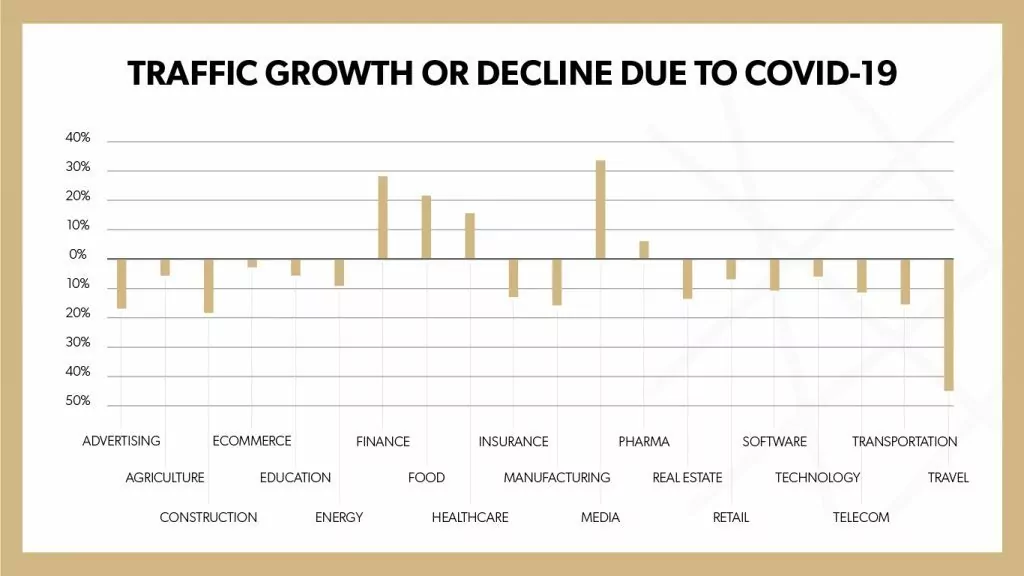
Source: https://neilpatel.com/blog/coronavirus/
People (customers) are searching less on Google for content relating to travel, transport or property. The flow of customers in these sectors may also be declining. At the same time, interest in other subject areas is growing, such as media and finance.
The reason for this lies in the changed circumstances. Whilst the current lockdown and travel restrictions are in place, citizens are unable to go on holiday abroad. Consequently, the number of enquiries on this subject is also falling. The corollary – that people are staying at home – raises the question of entertainment options. This is mostly met through media consumption, which is why demand is particularly high in this sector.
The people are the same. They are interested in other areas of life due to external circumstances; in other words, the customers haven’t gone away, but are simply inactive at the moment or ‘elsewhere’.
It is reasonable to assume that quite a few companies see this as a reason to cut their marketing and advertising budgets. That would be – or is – disastrous. As your customers are here to stay, you should also stay in touch with them. To this end, run adverts, which may well be cheaper due to reduced competition.
-> We’d be more than happy to advise you on which advertising options are currently recommended.
Social media campaigns, too, can help ensure that people remember you for the long term or even attract new customers. Investing in your own positioning is not just a question of cost-effectiveness these days. It is also a question of courage. As Warren Buffett (roughly) put it:
“Be fearful when others are greedy, and be greedy when others are fearful.”
Warren Buffett
Advertising prices work in exactly the same way as all other prices: they are determined by supply and demand. However, the process is similar to that of an auction. Let’s look at this using Facebook as an example.
Facebook acts as an advertising platform. Let’s assume there are 100 suppliers of the same product, but a stagnant number of people who can be reached with it. The higher the number of those wishing to advertise, the higher Facebook can set the price for adverts.
We are currently seeing a reversal of this situation. More and more people are going online and spending their time on social media platforms such as Facebook. At the same time, companies are cutting their advertising budgets. This means that Facebook has significantly less demand for adverts and a surplus of potential customers.
This means: supply > demand -> the price falls.
In figures: Facebook calculates, amongst other things, a so-called CPM (cost per mille). This figure indicates the amount of money required to generate 1,000 impressions. In January this year, the figure stood at around €3.70. Since then, an average of €2.55 has been recorded. That represents a fall of just under 31.1 per cent.
Now, with Easter just round the corner, people are also getting ready to stop working from home. So they’re likely to have even more time to spend online.
MAKE THE MOST OF IT!
The coronavirus crisis is forcing many sectors to rethink their approach. Educational institutions are closed and are not permitted to hold seminars in classrooms. As a result, video conferences are being organised. The same applies to concerts and lectures; even conferences are now being held exclusively via video conferencing. For these sectors, digitalisation offers a way to circumvent or even solve problems.
The situation is different for business models that rely on physical proximity to people. Tattoo artists, beauticians and hairdressers can only carry out their (main) work when people are present. Tradespeople, too, depend on being able to work on site. So is a digital solution conceivable for these professions as well? — Yes. At least to some extent.
Regardless of a business’s purpose, it makes sense to have an online presence. A website, a Google My Business listing and a marker on Google Maps should be updated regularly (or set up in the first place). But that’s not all. Everyone (!) can adapt part of their activities to the current situation through targeted online measures and thus continue to advertise successfully even during the coronavirus crisis.
Many marketers try to convince (potential) customers that the complete digitalisation of a business is a) sensible and b) necessary. This is incorrect. The implementation of individual marketing measures depends on the customer group being targeted. If your target customers are not active on social media channels, you will not reach them through these channels either. So why go down that route?
The answer lies in the question:
Would you like to retain existing customers and/or attract new ones?
The development of a marketing strategy always depends on its purpose or objective. Let’s look at two examples.
Example 1:
A cycle shop in Chemnitz (Saxony) specialises in downhill bikes and mountain bikes. Customers usually pop into the shop, discuss their requirements and can either leave their bikes in for repair, collect them, buy spare parts or purchase a new bike.
At present, business owners are not permitted to have direct contact with customers. So what can they do? The mechanics have come up with a solution. They have advertised on their website and on a number of social media channels that they can accept and return bicycles contact-free. Orders are placed via an automated online form or by telephone.
Customers are given an appointment to drop off their bicycle. Numbered combination locks are provided for this purpose outside the entrance to the workshop. The customer secures their bicycle to the lock specified in advance, the code for which is also sent to them automatically or by telephone. The process is repeated when they come to collect it.
Example 2:
A permanent make-up artist from Aschaffenburg was just as taken by surprise by the consequences of the coronavirus crisis as many other sole traders. Overnight, social contact was banned, effectively imposing an indirect ban on her work. However, she focused on two fundamental aspects:
She is currently acting accordingly. She is offering her network vouchers via Facebook and WhatsApp for fixed appointments in May, as she assumes: “At some point, the lockdown must come to an end. And even if not in May, then in June. But I can still arrange appointments.” She also posts offers for cosmetics in status updates and via Facebook and Instagram Stories, which can be purchased via her online shop.
The examples illustrate which aspects of a business can currently (and generally) be handled digitally: on the one hand, part of customer acquisition and sales, as well as arranging appointments; and on the other hand, customer management and customer care.
Please consider which process chains are in operation within your organisation and how they work. We’d be happy to discuss this with you and help you develop and implement a strategy to ensure your business continues to run smoothly even during the coronavirus crisis. Please write to us or give us a call. We’re here to help.