

Share with your friends!


Share with your friends!
The world of traditional SEO is changing – and radically so. Whereas search engines such as Google used to display ten blue links, direct, AI-generated answers are now taking centre stage. Any brand or content provider wishing to remain visible must understand how these new systems work – and how to optimise content for them.
Generative Engine Optimisation (GEO) describes precisely this new discipline: it focuses on the question of how content must be prepared for generative search systems such as Google SGE, ChatGPT Search or Perplexity.ai in order to be cited, referenced or displayed directly by them.
Unlike traditional SEO extensions, GEO represents a genuine shift in perspective.
Anyone who optimises solely for traditional SERPs today runs the risk of no longer appearing in AI-generated answers tomorrow.
Anyone who understands how AI processes content right now will gain a real edge.
Generative Engine Optimisation (GEO for short) is the practice of creating and structuring content in such a way that it features in the results returned by generative search systems – ideally as a cited source or recommended reference.
There are three key questions here:
Unlike traditional SEO, which focuses primarily on ranking in organic search results, GEO aims to appear within the generated answer itself – for example, in the form of an embedded snippet, a source reference or even as a directly quoted text block.
GEO stands for bringing relevant, structured, citable content to the digital forefront of AI search.
We are currently witnessing not only a technological transformation, but also a shift in user expectations. Rather than carrying out their own research, many users now expect a precise answer straight away – ideally contextualised, concise and action-oriented. This is exactly what generative engines deliver.
For businesses, the importance of online visibility is undergoing a fundamental shift. Whilst a high ranking in Google’s search results used to be the be-all and end-all, it is now increasingly the presence in AI-generated answers that determines trust, brand perception and, ultimately, conversion.
When users ask a question and the answer cites their own brand name or a product page as the source, this immediately instils trust – without the need for a traditional click.
This development has far-reaching consequences for content strategies. In future, brand authority will no longer be measured solely by how highly a website ranks on Google, but by whether it is cited in the response from a system such as ChatGPT, Perplexity or Google SGE. This is precisely what calls for a rethink in the way content is designed.
Nowadays, product pages, advice articles and service sections must not only be informative and persuasive for human readers – they must also be structured in such a way that machines can clearly understand, categorise and, where necessary, cite the content. GEO therefore means not just publishing content, but strategically designing it in such a way that it is comprehensible, concise and trustworthy for both people and machines alike.
| Type | Access to Live Web | Source visible | Current events | Ideal for GEO? |
|---|---|---|---|---|
| Training-based | ❌ No | ❌ No | Outdated | ❌ Not very much |
| Search-based | ✅ Yes | ✅ Yes | High | ✅ Very good |
| Hybrid | 🔁Partially | 🔁Sometimes | Depending on the situation | ✅ Complex questions |
The table provides a concise summary of the different ways in which generative engines are structured – and why this is crucial for GEO. This is because, depending on whether an engine accesses live web data or relies solely on trained content, the scope for gaining visibility with up-to-date content also changes.
Training-based models, such as GPT-4 without browsing, operate with a fixed body of knowledge. Visibility is only achieved here if content was already prominently available online prior to training. This means that early publication and subject-matter authority count for more here than technical optimisation carried out retrospectively.
Search-based engines such as Perplexity.ai operate differently: they access the web in real time, evaluate content based on structure, relevance and trustworthiness – and actively cite sources. This is where GEO comes into its own: anyone who provides structured, precise content with a high EEAT score can gain immediate visibility – even without significant brand authority.
Hybrid models such as Google SGE combine both – internal model knowledge and up-to-date web research. They are particularly demanding, as they require not only traditional SEO signals but also semantic and structural clarity. Anyone wishing to succeed in this environment must deliver on two fronts: technically sound content that is understandable to both crawlers and AI parsers.
The differences between these models are therefore not merely a technical quirk – they determine where and how your content still plays a role today. GEO means knowing which engine processes which content and how – and tailoring your content specifically to that.
Organic visibility on the internet is changing dramatically. Whilst traditional SEO measures have long been sufficient to achieve good rankings, generative systems are increasingly coming to the fore.
GEO is not optional. It is a response to a changing information ecosystem.
Content that is not AI-readable and citable will simply no longer be found – neither by users nor by machines.
A report in the Wall Street Journal (May 2025) provides strong empirical evidence of just how dramatically search behaviour is changing as a result of generative search engines:
Major players such as Intuit, Mailchimp, Ziff Davis and Red Ventures are already seeing a measurable decline in organic website traffic – not because their content is ranking lower, but because more and more users are content with AI-generated answers without clicking through to the linked pages.
Good content gets read – but people no longer visit the site.
GEO is not a substitute for SEO, but rather its logical next step. Anyone who masters GEO also masters SEO – but at a whole new level.
This means that SEO remains important – but it needs to evolve.
GEO is not the future instead of SEO, but the future of SEO.
To highlight the differences, it is worth making a direct comparison:
| aspect | Traditional SEO | Generative Engine Optimisation (GEO) |
| Objective | Good ranking in organic search results | Visibility in AI-generated responses |
| Search system | Google, Bing (classic) | Google SGE, Perplexity, ChatGPT, Gemini |
| Ranking factor | Keywords, backlinks, structure | Semantics, citability, reliability |
| KPI | Ranking, click-through rate, traffic | Presence in replies, mentions and visibility without a click |
| Content Focus | Keyword coverage & metadata | Contextual understanding & clarity for AI systems |
The short answer: Yes – but with new rules.
Traditional SEO measures such as technical foundations, local optimisation and keyword strategy remain essential. However, the ROI is shifting – clicks are no longer the only metric. In a world where generative AI systems provide direct answers, there is a risk that much content will remain visible but no longer be visited.
Small and medium-sized enterprises (SMEs) in particular face particular challenges in this regard:
Nevertheless, GEO can also be worthwhile for SMEs – provided you take a strategic approach.
For SMEs, this means:
Only those who consider both aspects together will remain visible in the long term – in search engines and generative systems.
In its ‘AI Visibility Pyramid’ framework, the content agency Animalz describes how content can be systematically prepared across three levels to ensure it is visible in generative search systems such as SGE or Perplexity:

In traditional search engines, the algorithm determines which pages are displayed and in what order. With generative search engines, the process works differently: content is not merely found – it is processed, weighted and integrated directly into the results.
But how exactly does your content end up in an AI-generated response?
Visibility is achieved in three steps:
The weighting of these factors varies depending on the search engine. Perplexity, for example, displays sources directly below the answer. Google SGE processes content in the background, but provides targeted links to selected reference pages.
In the GEO-BENCH study, published in 2024 by tech analyst Ethan Brooks, over 10,000 prompts were analysed in generative search systems such as Perplexity and ChatGPT.
The result:
Content with a structured outline, concise answers and semantic depth was cited up to 40 per cent more frequently in AI responses than shallow or purely keyword-driven texts.
Generative engines do not cite content at random. Behind every mention lies a complex assessment based on semantic relevance, technical structure and authority.
Tools such as Perplexity.ai or ChatGPT with browsing mode specifically access such content and link to it explicitly. The difference compared to a traditional search is that there is no chance of a click without a citation.
Trust is a key selection criterion for generative engines – particularly when it comes to deciding whom to cite. In doing so, the systems are guided by signals that convey trust in terms of both technical aspects and content.
If you want to be recognised as a source, you need to demonstrate to both users and search engines that this content is accurate, clear and reliable.
To be visible on traditional search engines, we have learnt that it’s all about good content, keywords and backlinks. But in the world of generative engines, the rules of the game have changed. Content must not only be found, but also understood, analysed and incorporated directly into AI responses.
That is the role of Generative Engine Optimisation (GEO). And GEO only works if you optimise content in three dimensions:
Entities are ‘fixed terms’ with a clear meaning – for example, Shopify, SEO, iPhone 15 or Google Analytics. They help the AI understand what your text is about.
If you’re writing about ‘Email marketing for Shopify shops’, you should make it clear that:
You build authority on a topic not just by writing a single article on it, but by creating a whole range of content that explores the topic from different angles. For example:
This tells the AI: This website knows its stuff – it’s trustworthy.
This increases the likelihood that your content will be mentioned or even quoted in AI-generated responses.
In the past, people often crammed texts full of the same keyword (‘keyword stuffing’) in order to rank higher. These days, that tends to have the opposite effect – and it doesn’t work with AI anyway.
Instead, you need a clear, logical structure so that the AI can ‘understand’ your content:
Objective:
Don’t just ramble on; phrase it in such a way that an AI can construct a response directly from your text.
Even the best text is of no use if machines cannot read or analyse it. GEO requires your content to be technically sound and readable by AI systems.
Structured data is additional information that you embed in your website’s code. It helps search engines and AI systems understand what kind of content they are looking at.
Examples:
You can incorporate these mark-ups using JSON-LD code. Tools such as the Schema Markup Generator from technicalseo.com can help you with this.
This is particularly important for GEO because many generative engines (such as Google SGE or Bing) actively use these mark-ups to structure or cite content.
As well as structured data, the structure of your content also plays a role:
Avoid technical barriers such as:
The easier it is to access and read your content from a technical point of view, the better it is for GEO.
Generative engines often create what are known as AI snapshots – that is, short, concise answers to a user’s question. If your content is clear and helpful, it may appear there.
What helps:
Aim: Your website won’t just be linked to – it will appear directly in the answer.
Even the best content needs a framework: good planning, clear objectives and a logical place within your website’s structure. This is all the more true for GEO.
Instead of simply choosing topics based on gut feeling, you should consider:
Create a topic map (content cluster) and prioritise content that is suitable for AI citation – in other words, informative, clear, up-to-date and helpful.
Update your evergreen content regularly – outdated articles are cited less often by AI systems.
A pillar page is a comprehensive main article on a key topic. It serves as an anchor point for other, smaller sub-pages.
Example:
This helps:
GEO needs depth – and you achieve that through well-structured, interconnected content.
GEO isn’t just a concept – it can also be put into practice. You don’t need any special software to do this; what you need, above all, is a good understanding of three things:
Below, I’ll show you some specific tools and methods you can use to check and optimise your content for GEO compatibility.
Before you spend hours fine-tuning technical details, you should be able to answer one simple question:
Is my content even mentioned or used in AI responses?
Two tools that can help you with your exam are ChatGPT with its browsing function and Perplexity.ai. Both access the web and show you which content they consider relevant.
➡ If you don’t turn up, think about this:
➡ If ChatGPT recognises or cites your site, that’s a strong signal.

Well-known content tools such as Neuronwriter and Surfer SEO were originally developed for traditional SEO – but they can also be used very effectively for GEO, provided you know what to look out for.
Well-known content tools such as Neuronwriter and Surfer SEO were originally developed for traditional SEO – but they can also be used very effectively for GEO, provided you know what to look out for.
Both tools help you create semantically rich content. Here’s how to use them specifically for GEO:
💡 GEO tip: Write your paragraphs so that they are concise, precise and quotable.
💡 GEO tip: Write section headings as questions so that AI systems can pick them up more easily.
The field of ‘Generative Engine Optimisation’ is still in its infancy – many companies are only just getting started. As an agency, we too have not yet carried out any specific GEO projects, but have primarily helped our clients achieve visibility through traditional, yet structured, SEO.
Yet it is precisely this experience that shows that the overlaps between SEO and GEO are already measurable today.
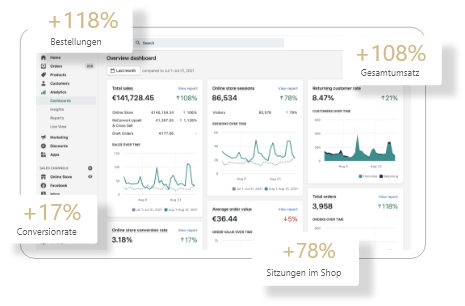
For our client Soulspice – an organic spice manufacturer specialising in fair trade products – we have spent several months implementing a structured SEO strategy:
Although GEO was not explicitly the target of the measure, the site now features in Perplexity prompts for questions such as:
cited by Perplexity as the source.


This shows that SEO optimisation characterised by structure, clarity and thematic depth is already being rewarded by generative search engines – even without a targeted GEO strategy.
We are currently at the start of a new phase:
Over the coming months, we will be deliberately testing which measures actually lead to citations in generative search engines.
These include:
We will document the results on an ongoing basis – and update this article as soon as genuine benchmarks become available.
Organic search is undergoing a major transformation. Traditional SEO remains relevant, but anyone who focuses their content solely on rankings and clicks is taking too narrow a view. With the rise of Google SGE, ChatGPT and Perplexity, visibility is shifting to platforms where answers are generated directly – rather than simply linked to.
Generative Engine Optimisation (GEO) is the answer to this trend:
At the same time, the following applies:
GEO will not replace SEO – it will complement it.
The best results are achieved where traditional SEO principles – such as structure, keyword relevance and technical foundations – are combined with GEO factors such as citability, entity strategy and AI comprehensibility.
Anyone planning content today should pursue two objectives simultaneously:
- Top rankings in the SERPs
- References and citations in AI-generated responses
SEO and GEO are converging – to form a holistic strategy for organic visibility in a world both with and without clicks.
Anyone who ignores GEO will suffer a significant loss of visibility in the long term.
Anyone who gets on board now can gain a real head start in a discipline that is still in its infancy – and take their SEO to the next level in the process.
We’re here to help – from analysing your existing content to targeted GEO optimisation of your content.
Want to find out how your content appears in AI searches? Let’s carry out an initial assessment together – with no obligation, but in depth
Generative Engine Optimisation (GEO) is the practice of structuring content in such a way that it is cited or referenced in the responses provided by AI search systems such as ChatGPT, Perplexity or Google SGE.
Generative AI optimisation refers to measures designed to ensure that content is formatted in such a way that it is visible, comprehensible and citable in the responses provided by AI systems such as ChatGPT, Gemini or Perplexity.
SEO optimises content for traditional search engine rankings, whilst GEO designs content so that it is visible and quotable in AI-generated responses – regardless of clicks or rankings.
| SEO (traditional) | GEO (modern) |
| Ranking in Google SERPs | Quoted in AI responses |
| Keyword focus | Context & Citation |
| Click optimisation | Answer optimisation |
No, GEO does not replace SEO. GEO complements SEO by further optimising content for generative AI systems – visibility today is achieved both in search results and in AI-generated responses.
Yes, SEO remains relevant – but it needs to adapt. With the emergence of generative AI systems, the focus is shifting from rankings towards citable, structured and trustworthy content.
“GEO instead of SEO” describes the shift in online visibility: away from search result rankings and towards a direct presence in AI responses – GEO does not replace SEO, but rather expands it to meet new requirements.
The ROI of traditional SEO measures declines when content is no longer clicked on, but instead answered directly via AI. However, location-based content generates new visibility, trust and indirect conversions – even without clicks.