

Share with your friends!

Share with your friends!
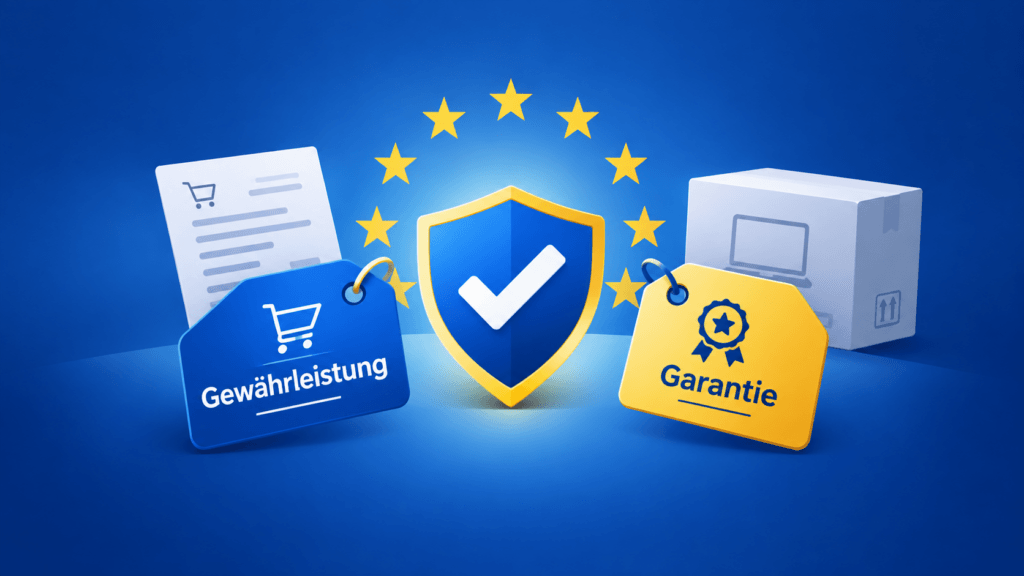
From 27 September 2026, a new information requirement will apply to online retail in the EU: the EU warranty label. When selling products with manufacturer’s warranties, the so-called GARAN label must also be displayed. Both labels are standardised across the EU, apply without a transition period and with no exceptions based on shop size or sector. This guide explains the legal basis and shows you how to implement the labels in your Shopify shop.
The basis for the new obligation is EU Regulation 2025/1960. It forms part of the so-called EmpCo (Empowering Consumers) package on consumer protection. As this is a regulation and not a directive, it will apply directly from 27 September without first needing to be transposed into German law. The obligation to comply applies to B2C online retailers, regardless of turnover, product range or sector.
Two new, EU-wide standardised labels are being introduced:
Both labels are required in addition to existing legal documents such as the terms and conditions or the cancellation policy, as part of the online retailer’s additional duty to provide information.
Before moving on to the technical implementation, it is worth making a clear distinction between the terms, as this gives rise to different obligations.
| Quality assurance label | Guarantee label (GARAN) | |
| Legal basis | Annex I, Regulation (EU) 2025/1960 | Annex II, Regulation (EU) 2025/1960 |
| Who has to show it? | Every B2C retailer, without exception | Only if the manufacturer’s free warranty covers the entire product for more than 2 years |
| Contents | Pre-set, cannot be changed | The make, model code and warranty period must be added |
| Scope | Across the whole shop | product-specific, per item |
| Distinctive feature | Static image with a QR code linking to the EU’s ‘Your Europe’ portal | Circumstances triggering the obligation to provide full details of the warranty terms and conditions |
The statutory warranty (the seller’s liability for defects, at least two years for new goods) and the voluntary manufacturer’s guarantee remain, in legal terms, two separate matters. The new labels do not alter this in any way – they merely stipulate how information about both must be provided.
Both labels are standardised down to the last detail. Customised designs are not permitted – the templates are provided by the European Commission and must be used as they are.
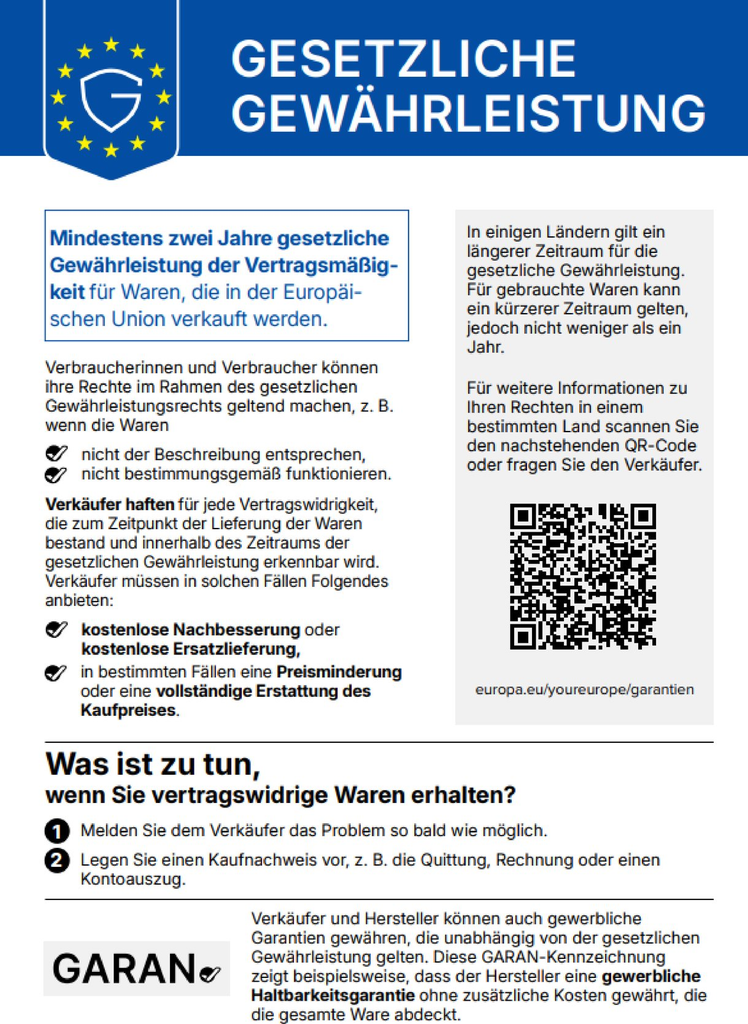
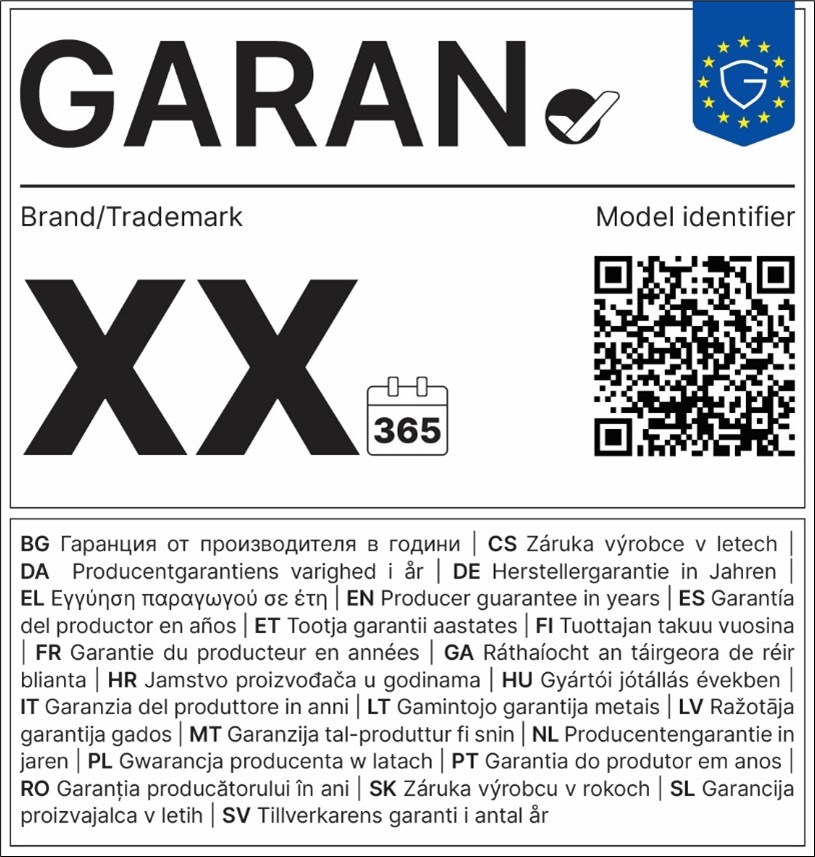
The following applies to the standard Shopify checkout: it must be displayed in colour, there is no fixed minimum size, but the QR code must remain readable under normal conditions using a standard smartphone.
The files are available to download here free of charge
The EU regulations do not specify a particular location for the guarantee label, such as ‘below the “Buy” button’. However, they do require that the label:
is integrated. The following locations are therefore possible for correct integration:
Only the coloured version of the warranty label may be embedded directly as an image. A nested display – such as one that only appears on mouseover or after clicking a tab – is not permitted. Similarly, the label must not simply be displayed as part of a product image gallery.
The guarantee label must also:
be incorporated. As a warranty is product-specific, the label must be displayed on the relevant product detail page. Unlike the guarantee label, it cannot be incorporated into the checkout process. However, with the warranty label, it is possible to incorporate it directly as an image or as a nested advert. In the case of a nested advert, care must be taken to ensure that it is clearly visible to the naked eye and is displayed in an equally prominent position on the product detail page.
Shopify does not currently support these labels natively. This means that, unless you take action, your shop will not display a legally compliant label on 27 September 2026 – and you will therefore be at risk of receiving a formal warning.
There are essentially two ways to carry out integration:
This approach requires knowledge of custom code (Liquid, Metafields, and possibly Checkout Extensibility) and ongoing maintenance, for example when theme updates are released, as these may overwrite the custom code.
For retailers who wish to avoid the hassle of manual implementation, there are already specialised apps available in the Shopify App Store that automatically comply with the requirements of the regulation. Typical features of such solutions include:
The app-based approach significantly reduces the technical workload. However, it does not replace a content check: retailers must still ensure that they accurately maintain a record of which products actually come with a free manufacturer’s warranty of more than two years.
27 September 2026 is a fixed deadline with no transition period – for every Shopify shop that sells goods to consumers in the EU. Whilst the warranty label is relatively straightforward to integrate as a static, shop-wide element, the product-specific GARAN label requires meticulous data management via Metafields or a specialised app. Those who plan ahead can complete implementation well before the deadline – those who wait risk an unnecessarily high likelihood of receiving a warning letter from the end of September onwards.
If you need help integrating the warranty or guarantee label into your Shopify shop, please feel free to get in touch with us.
The EU guarantee label must be incorporated into the online shop from 27 September 2026.
No, the obligation to display the warranty and guarantee label applies only to physical goods sold to consumers (B2C). Digital goods, services and purely B2B transactions are not covered by this regulation.
Possible locations for incorporating the warranty label include the product details page or the checkout page.
No, the guarantee label (“GARAN”) only needs to be included in the case of a voluntary manufacturer’s guarantee lasting more than two years.
No, the labels must be clearly visible before the contract is concluded.
No, the appearance of the labels is strictly defined across the EU and, as a general rule, must not be altered. Only in the case of the GARAN label must the duration, manufacturer and model be adapted to suit the product.