Share with your friends!


Share with your friends!
Our experience with Shopify from client projects can be summarised briefly as follows: for brands that sell products to end customers, Shopify is a good choice because it remains easy to use and the system scales as the business grows. On its own, however, it doesn’t generate any revenue; it costs more than the entry-level price; and it reaches its limits when it comes to very specific business models or requirements for the checkout process.
These aren’t posts by anonymous forum users. Golden Web Age has been working with online retailers since 2017, and the examples below are taken from our own projects, as recounted by the clients themselves. This also means that we earn revenue from Shopify projects and are not a neutral testing body. That’s why we highlight what the figures don’t show.
| Project | Shop system | Phase | Result |
|---|---|---|---|
| SILBERTHAL | Shopify | Scaling | Online turnover of around €300,000, heading towards €3 million a year |
| Sugar decorations | WooCommerce, then Shopify | System change | Turnover has doubled since the partnership began |
| Miomente | Magento, not Shopify | Counterexample | A heavily customised system for a special edition model |
Miomente is deliberately included in the list, even though the shop isn’t hosted on Shopify. You can find out why further down in the ‘Limitations’ section.
The low cost of getting started is the obvious advantage. In our video on the benefits of Shopify, Christian explains that you can try it out on a small budget and don’t have to worry about maintenance, updates or backups. This is in line with what we’ve observed. The basics are covered in detail in our article on the pros and cons of Shopify, so here we’ll just focus on what the projects reveal in addition to that.
SILBERTHAL was already running on Shopify before we came on board. The shop had been built by the founder himself, using a standard template that offered little scope for customisation. Philipp Landsgesell, who is now in charge of the online shop, describes it as very white and sterile. The shop was functional and the conversion rate was acceptable, but annual turnover remained at around €300,000 and it failed to showcase the brand.
The lesson learnt: setting it up yourself is enough to get started. As soon as the shop is intended to be a brand’s central point of contact, the template becomes a limitation, and someone needs to be able to implement it technically. SILBERTHAL lacked the in-house capacity to do this.
Zuckerschmuck sells products for people with diabetes. Founder Sonja started out with a modular system, but found it had its limitations when it came to bilingual functionality and stock management, and ended up using WooCommerce via an agency. According to her, this resulted in “far too many plugins”, and the system kept crashing due to the plugins and updates.
Even so, the switch to Shopify wasn’t an easy one for her. For a long time, the question remained as to whether the costs were worth it to start all over again. Looking back, she says: “Everything is simpler; it’s easier for us to manage, and it’s easier to keep track of stock.”
Since we started working together, turnover has doubled. But that’s not down to Shopify alone: over the same period, our product range expanded significantly, and we optimised our Google Ads campaigns. Anyone who promises you’ll double your turnover simply by switching systems is trying to sell you something.
Don’t feel like reading? Sonja explains in the video why she made the switch; she gets to the reasons at 5:36:
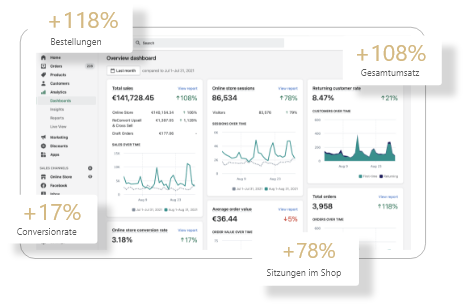
SILBERTHAL is the most telling example when it comes to the question ‘Is Shopify any good?’, as the platform remained the same. Before the collaboration, the shop was running on Shopify, and it continued to do so afterwards. The difference lay in what happened on the platform:
The end result is online turnover which, according to Philipp, is heading firmly towards €3 million. His conclusion: “A shop like this is never really finished.” There is no mention in the conversation of any technical limitations imposed by Shopify. According to Christian, the biggest problem was stock levels, and no shop system can solve that.
Don’t feel like reading? Philipp tells the whole story in the video; the figures come in at 14:50:
The starting price is not the total bill. These are the pricing plans, as at November 2026, according to Shopify’s pricing page:
| Rate | Monthly | For annual payments, per month | Fee charged by an external provider | Shopify Payments online |
|---|---|---|---|---|
| Basic | 36 € | 27 € | 2 % | 2,1 % + 0,30 € |
| Grow | 105 € | 79 € | 1 % | 1,8 % + 0,30 € |
| Advanced | 384 € | 289 € | 0,6 % | 1,6 % + 0,30 € |
| Plus | from €2,100 | not specified | 0,2 % | 1,3 % + 0,30 € |
There is a 3-day free trial; after that, most plans cost €1 per month for 3 months (as of November 2026).
On top of that, there is something that isn’t mentioned in any pay scale:
You can find out more about which plan is right for you in the overview of Shopify costs.
Checkout: According to Shopify, apps that customise the information, dispatch and payment stages are only available with Shopify Plus. If you need custom fields or logic there, you’ll pay from €2,100 per month. Our comparison of Shopify and Shopify Plus will help you decide whether it’s worth it.
B2B: Basic features are also available on lower-tier plans. According to Shopify, assigning catalogues directly to individual companies and locations – i.e. setting prices on a per-customer basis – is only possible with the Plus plan.
URLs: The paths /products/ and /collections/ cannot be removed; only the part that follows them can be changed. It’s not the end of the world, but if you move your site, every old URL must be properly redirected.
Special offers: This is where Miomente comes in. The company sells cookery courses and tastings in the form of tickets and vouchers that can be redeemed later. There’s a dedicated redemption portal for this, and the whole thing runs on a heavily customised, older Magento shop. Maike Retzer explains that nothing there can be easily solved with a plugin.
That doesn’t prove that Miomente wouldn’t be possible on Shopify; the project doesn’t say anything about that. However, it does highlight the question you should clarify before choosing a system: does your purchasing process fit into the ‘product, basket, checkout’ model? If not, plan to create prototypes before committing to a large budget. That’s exactly what Maike advises, too.
Don’t feel like reading? From 14:19, Maike explains what a highly adapted system means in everyday life:
Shopify is worth it if you sell products to end customers, don’t want to deal with servers and updates, and want to grow your business. It’s generally not worth it in the following cases:
Anyone looking for a Shopify review will quickly end up on Trustpilot. As of 9 November 2026, Shopify had a rating of 1.3 out of 5 stars based on 5,293 reviews. That sounds damning, but it says little about whether it’s suitable for your shop: many complaints come from buyers who ordered from a fraudulent shop running on Shopify.
You should take seriously the feedback from retailers describing poor support and shops being suspended. You’re running your shop on a third-party platform and, if problems arise, you’re reliant on their support.
Would you like to know whether Shopify is right for your shop, or why your Shopify shop isn’t growing? During an initial consultation, we’ll spend 30 minutes discussing your requirements – free of charge and with no obligation – and identify where the biggest opportunities for improvement lie in your shop. Book your initial consultation via our contact page, or take a look first at what we, as a Shopify agency, can do for you – from set-up to scaling.
This also depends on the payment processing. If all your turnover is processed via external providers, Grow is cheaper than Basic for monthly payments once your monthly turnover reaches €6,900, as you save 1 per cent in fees but pay a basic fee that is €69 higher (as of November 2026). If you use Shopify Payments as your main provider, this threshold changes.
Not when you’re just starting out – you can set up a shop yourself. It makes sense to seek help when a template is no longer sufficient or you lack the internal capacity. Based on her experience with previous agencies, Sonja advises: start with a small project, check that prices are adhered to, and describe the scope very precisely.
Depending on the design, features and number of products, a professionally built online shop can take anywhere from a few weeks to several months. You can get a simple online shop based on a template up and running much more quickly yourself.
Yes, SILBERTHAL demonstrates this with millions in turnover via its online shop, and Christian counts scalability as one of the biggest advantages. We see limitations more in terms of special requirements at checkout and in B2B, which require the Plus plan.